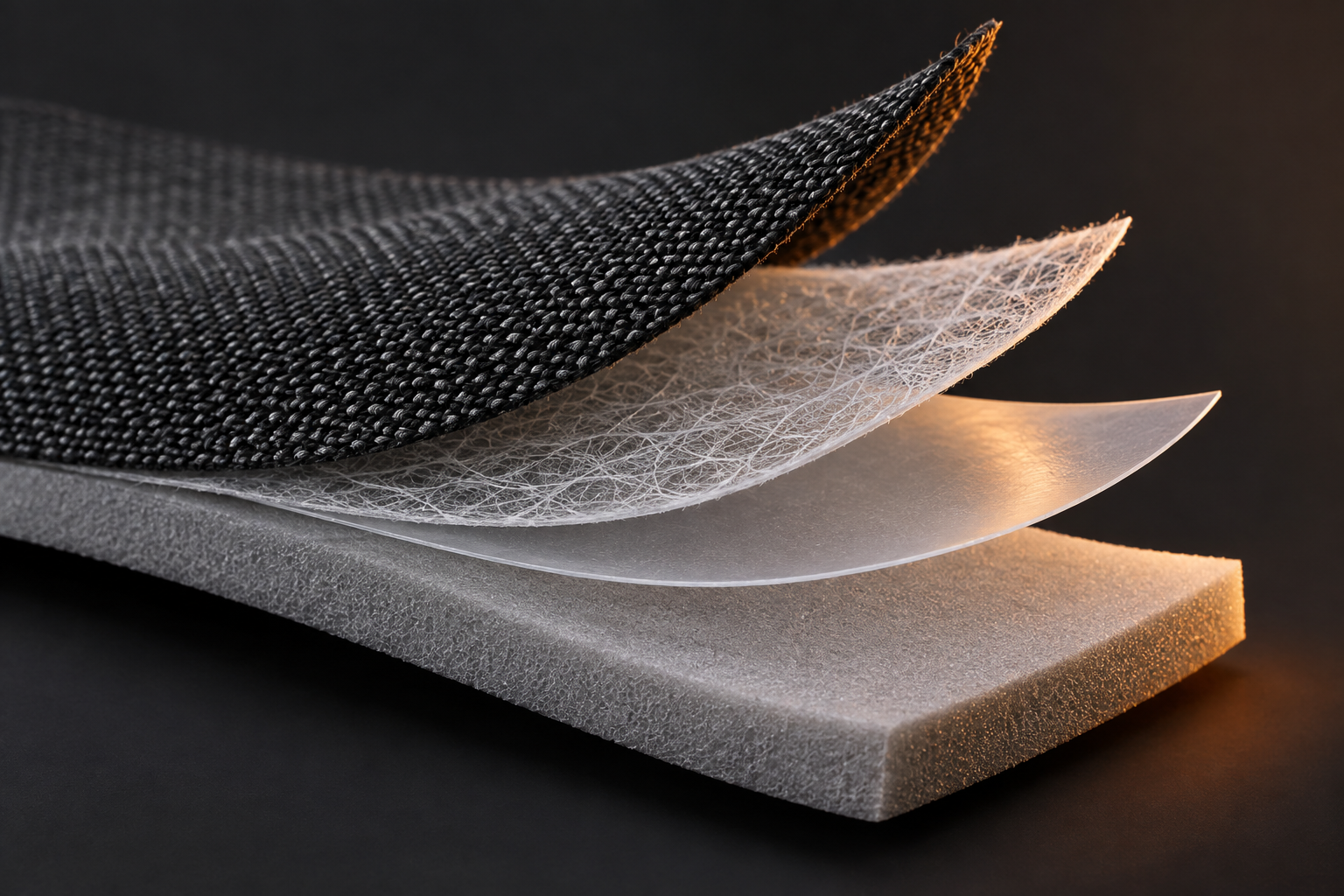
WebsNonwoven adhesive webs
A fine, fibrous adhesive layer placed between materials. An option to consider when softness and laminate permeability matter.
Maliplast offers copolyamide, copolyester and polyurethane adhesive webs.
Ask about webs +
BONDING TECHNOLOGIESABIMEX × MALIPLAST / HOTMELT
Adhesive webs, films and nets for lamination. Match the bonding layer to your materials, process and product requirements.

Fabrics
+Foams
+Leather
+Nonwovens
+Layered materials
01 / PRODUCTS
Adhesive structure matters. Explore three hotmelt formats and find a starting point for selection.
A fine, fibrous adhesive layer placed between materials. An option to consider when softness and laminate permeability matter.
Maliplast offers copolyamide, copolyester and polyurethane adhesive webs.
Ask about webs +A uniform adhesive layer for full-surface bonding. Film selection considers flexibility, substrate characteristics and service conditions.
Maliplast offers TPU- and EVA-based films.
Ask about films +An open structure with regular mesh openings. An alternative for applications where adhesive distribution and an open bonding layer are important.
Specifications and available grades are determined for each enquiry.
Ask about nets +Final bond properties depend on the specific adhesive, materials and process settings. Selection is confirmed by a lamination trial.
02 / APPLICATIONS
From soft textiles to layered interior components. Every application has different requirements.
MATERIAL + FUNCTION
Laminating woven fabrics, knits and lace with reinforcement or foam. The starting point is preserving the fabric's feel and the properties needed in the finished garment.
03 / TECHNOLOGY
Hotmelt webs, films and nets are placed between materials as a dry layer. The process is matched to the adhesive and substrate.
Match the adhesive format, width and amount to the substrate surface and structure.
Heating allows the adhesive to flow. Contact time and pressure must enable bonding without damaging the materials.
After cooling, assess adhesion and laminate performance under conditions relevant to its intended use.
PROCESS AND ENVIRONMENT
Dry webs, films and nets enable lamination without a liquid adhesive carrier. This offers specific opportunities to reduce environmental burdens during processing.
Compared with solvent-based adhesives, no solvent needs to be removed from the applied layer. This avoids emissions associated with that step.
Compared with aqueous dispersions, there is no water to evaporate from the adhesive. This can simplify the line and reduce energy needed for drying.
Choosing the layer weight and width helps match the adhesive quantity to the task and limit excess. Actual savings should be assessed in a trial.
The balance depends on the process. Heat activation still requires energy. We do not claim zero emissions or an invariably lower environmental footprint: comparison requires data on temperature, throughput, ventilation and waste. The finished laminate is not automatically recyclable.
04 / ABIMEX × MALIPLAST
As a representative of Turkish manufacturer Maliplast, we help you move from an application brief to a hotmelt solution. We start with your materials and the result you need.
Ask us about webs, films and nets for lamination. We will establish the information needed to select a product and prepare a quotation.
Meet the manufacturer: MaliplastABIMEX CERTIFIED MANAGEMENT SYSTEMS
Quality and environmental responsibility are part of how we operate.
GOOD TO KNOW
A web has a fine fibrous structure, while a net has a regular mesh pattern. Both are open structures, but distribute adhesive differently. Evaluate the choice on your actual materials.
This should not be assumed. Adhesive films bond layers. Waterproofing, water-vapour permeability and barrier functions require verification for the particular product and finished laminate.
Not every adhesive bonds every substrate. Composition, surface finish, porosity and heat resistance all matter. Confirm selection with a trial, especially with coated materials.
Describe the composition of both layers, the product's intended use, requirements after washing or heating and your lamination method. Working width and estimated consumption are also useful.

05 / ADHESIVE SELECTION ENQUIRY
Describe your materials and the desired result.
That is where good adhesive selection starts.